



The Power of Data


Synopsis
Every click leaves a trace. But who owns it?
The Power of Data traces the arc of our digital lives, from ARPANET to the IoT, from cybercrime to blockchain, asking not just how these systems work, but who they ultimately serve. And what remains of privacy when the answer is uncomfortable.
On a Sunday morning, driving along an empty highway veiled in fog, the soft hiss of air clearing the haze can make it easy to imagine that you are somewhere else, a world away, perhaps even a universe away. The Power of Data creates a similar sense of displacement, but by entirely different means. From its very first frame, a flat geometric form suspended in a web of light rays, the film makes its method clear: there is no camera, no physical location, and no archival footage. Its world is constructed entirely from data. In the directorial debut of Italian producer and scholar Marco Milone, better known for helping bring other filmmakers’ visions to the screen, the focus turns to something conventional documentary grammar can barely contain: the invisible architecture of the networks that carry our digital lives, and the question of who that architecture ultimately serves.
The premise is simple: every click leaves a trace. But who owns that trace? From there, the film moves through a technological history stretching from ARPANET to the Internet of Things, from early cybercrime to the hype surrounding blockchain, without showing us a single screenshot of the world it describes. This is the film’s boldest stylistic choice, and perhaps its most successful. Milone is dealing with systems such as protocols, flow diagrams, and relational architectures, things that have no obvious physical place to be filmed. They operate in logical rather than geographical space. The film responds by building its own visual language from diagrams, typographic cards, and geometric animation. Even before a word of narration is heard, that language already carries force.
Directed by
Marco Milone
Marco Milone
Written by


Marco Milone


Because Milone’s selection of historical material consistently avoids the obvious, this 19-minute essay film never settles into an illustrated lecture. Rather than relying on familiar technological landmarks, it turns to stranger and often more revealing episodes: the 1972 Playboy cover image that became a standard test image for compression algorithms; pornography broadcast onto enemy frequencies during the Iraq War, less to offend than to jam a channel; and nineteenth-century composite photographs of Empress Elisabeth, sold as authentic portraits long before the term “deepfake” existed. Together, these vignettes do more than establish a chronology. They suggest that many of the ethical dilemmas we now associate with the digital age were already latent in the tools themselves, waiting for the infrastructure to catch up.
One of the film’s more intelligent structural choices is its refusal to provide a villain. Milone has explained that he did not want to make a film about danger because danger implies an enemy. These systems, in his view, do not have enemies; they have users. That distinction is embodied in the silhouette that recurs throughout the film, a figure without gender, interior life, or narrative arc. It is neither a victim nor a perpetrator, but a position within a system. Refusing to sentimentalize that figure is one of the film’s more disciplined choices, though it also keeps the viewer at a certain emotional distance.
Sound is particularly important here. The visual register remains deliberately flat and schematic, leaving the sound design to carry much of the emotional and atmospheric weight. As Milone describes it, nothing is allowed to swell at the same time, a kind of anti-crescendo principle. The three unnarrated structural pauses that punctuate the film are among its most striking moments. Their silences feel composed rather than empty: small architectural breaths that allow the preceding information to settle before the next historical current pulls the viewer forward.
What makes the film’s ending particularly difficult, and productive, is that it refuses to fully resolve one question: how much anonymity should be tolerated for a content user, compared with a content creator? Public debate often collapses distinctions like this into a generic and ultimately unhelpful discussion of “privacy.” Milone does well to preserve the asymmetry rather than force a conclusion. In the end, this is a film more interested in setting a process of thought in motion than in offering reassurance. Viewers looking for a thesis-driven argument with an easy conclusion may find its rewards more elusive.
“The Power of Data offers something rarer: a genuine attempt to make the invisible logic of our networks visible without simplifying its complexity.”


Italy · 19 min · 2026
Marco Milone
Produced by
Despite a title that initially feels somewhat awkward, The Power of Data is a bold and formally rigorous essay film, more indebted to schematic diagrams and typographic rhythm than to traditional modes of documentary storytelling. It will not be for viewers looking for a narrative embrace or human faces to hold onto. But for those willing to sit with its cool, deliberate distance, it offers something rarer: a genuine attempt to make the invisible logic of our networks visible, and to remain, without flinching, with the weight of what that logic implies.


There is also a self-reflexive, almost penitential irony in the film’s production itself: it was made for less than one thousand euros using some of the very tools it scrutinizes, including AI-assisted software. Rather than weakening or distorting the critique, that fact makes the film feel less like a gimmick and more like an extension of its central concern with complicity and structure.
“This is the film’s boldest stylistic choice, and perhaps its most successful, building a visual language from diagrams, typography, and geometric animation.”
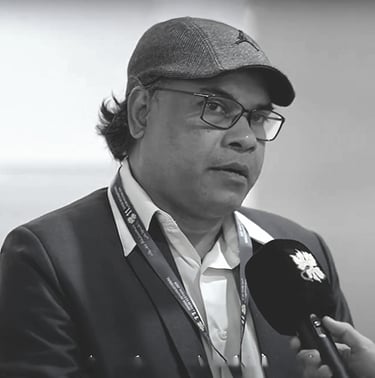
Ashraf Shishir
Luminous Frames & International Emmy Awards Juror | Golden Globe Voter
© 2026. All rights reserved.