




THE CORE


Synopsis
At the twilight of his life, a man whose obsessive quest for truth has led him to the edge of an abyss is visited by metaphysical entities who try to prevent him from diving further into it. Each entity offers its version of order and salvation, but the need to gaze beyond and search as deep as possible is strong, even if it might result in a one-way ride to damnation.
When obsession through experience begs metaphysics, and/or truth is sought, the seeker may well find himself voluntarily engaged in a massive specter of supernatural horror and spiritual damnation, particularly in the face of how frequently the elite theories of human knowledge and understanding fail. Craig Murray presents THE CORE, a visual sensation of an experimental short film that reinvigorates the music video form, making the inquirer’s demand for endless discovery its driving force.
Following their award-winning collaboration, DEAD DREAMS FALLING, which, among its accolades, won Best Experimental Film at the 2023 Luminous Frames Film Festival, Murray and French multidisciplinary artist Amine Boucekkine move into the realm of the cinematic musical short. The film offers none of the safety nets of conventional narrative, instead throwing viewers into a hallucinatory world where metaphysical beings compete to claim the soul of a dying man, vehemently asserting their own miracles of redemption as he remains mesmerized by truths that cannot be understood.
Under Murray’s direction, with its dedication to practical, handcrafted effects in the style of Georges Méliès and an unparalleled performance by Rufus White, THE CORE works simultaneously as a warning and an exploration of knowledge: whether there are limits beyond which knowledge costs us too dearly, and whether the human desire to know may itself become the very thing that leads to our undoing.
The movie revolves around an unnamed elderly man, Rufus White, who plays the role with scary intensity, and has assigned his entire life to fanatical search of the truth. Since he is standing at twilight, literally and metaphorically the sun is setting on his life and mortality is catching up with him, he is literally on the side of an abyss which is to be either enlightening or literally awful. It is not the meditation of the philosopher in his retirement but something much more graphic and threatening: a man who has glimpsed too long in the darkness and who finds it drawing him in with gravitative power. Murray creates the state of mind based not on exposition, but instead on the accumulated decades of obsession using the weathered face of White and shaking physicality to share the obsession of the state.
What makes THE CORE more complex than more simpler narratives about a spiritual crisis is the entry of metaphysical beings represented by truly impressive ensemble featuring Jordaine Lincoln, Isabel Le Cras, Edain Bradley, Will McGeough, Mark Beagent, Marta Gambarotto, Joss Carter, and Lauren Bridle who come in to rescue the old man in his final fall. They will be not traditional angels or demons but something more generic, the creatures of the other dimensions that cannot be perceived by just a regular person that offer their own cosmology, their own system of cognizing the nature of existence. Others provide order, structure, assuring comfort of preexisting belief systems. There are those who guarantee salvation by submission, submission to mystery instead of its unwearying questioning. But each of which, however well meaning its intentions, essentially misconceives what motivates this man: the necessity to look further, is not a matter of will he chooses but a necessary trait of his nature, even to his certain damnation.
Directed by
Craig Murray
Amine Boucekkine
Written by


Craig Murray


Murray and Boucekkine stem the movie as a pattern of conflicts between the old man and these supernatural intruders where each successive encounter with them shows a new aspect of the underlying philosophical dilemma. The entities are rendered with authentic sets that are hand-built, and some practical effects that are intended in the pre-meditated homage to the pioneer of cinema Georges Melies. The results of this purist are impressive--in an age of digital effects, the homey reality of the supernatural world of Murray is deeply disturbing. The sets are quite primeval and alien at the same time, built of the materials that appear to exist against the natural law. The metaphysical is pegged on the physicality by the practical effects that bring the impossible too close.
Cinematography which Boucekkine highlights as having been given special concern, serves, as he correctly puts it, to the production of what he refers to as a metaphysical nightmare. Compositions favored by Murray and his cinematographer help underline the isolation of the old man in the middle of creatures, adding depth and shadow to indicate the spaces of infinity which are pressing on each side. Its color arrangements lean towards cold descriptive colors interspersed with bursts of blistering brightness the abyss itself, maybe, or the truth the old man seeks but which creates a visual palette which can be seen as out of touch with reality. Camera movements are not incidental, but rather tend to be dizzying, and they move across in-impossible geometries that Escher would be familiar with, and that further adds to the impression that we have stepped into the world where our normal spatial sense no longer applies.
The music, necessary in terms of ordering in that Boucekkine himself was the composer of the music which is the driving force of the film, serves not in terms of accompaniment, but in terms of being the heartbeat of the film. The sound environment is manipulative and problematic as it creates tension dissonance and disrupted harmonies reflecting the mental condition of the old man. The rhythm controls the speed with which supernatural confrontations are dealt with, picking up like the abyss as the latter approaches, establishing an unstoppable flow that is as compulsible as the old man. It is movie as gesamtkunstwerk, whereby the visuals and the sounds are combined to form one massive attack on the senses and this is meant to engulf, not entertain.
This has been grounded to forceful emotional reality, through the performance by Rufus White. He is not just somebody who symbolizes his old man but he is a living being, someone who has lost all to find meaning, probably sanity itself. White expresses this in unobtrusive pieces of physical evidence: how his hands tremble not with age, but with necessity, how feverish the look in his eyes when the creatures recite their different gospels, how slightly his body leans forward as though he himself were being drawn opposite ways by gravity itself, whose work had been the things seen beneath. The ensemble of entities provide a range of energy to their job, making the realm of supernatural presence not just benevolent to threatening, but truly dangerous, though it was a wise choice by Murray to ensure that their actual natures remain ambiguous.
The narrative structure of the film cannot readily be summarized, as it functions as visual metaphor and symbolic challenge as opposed to the traditional plot mechanics. The conception presented by Boucekkine, which could be characterized as featuring a complex narrative structure, is not as linear as a spiraling process, making its way around the main question whether the pursuit of truth can be turned into some kind of damnation. The proposal of salvation by each of the entities is that of a different school of philosophy: faith, rather than doubt, acceptance, rather than enquiry, the safety of assurance, rather than the horror of the unknown. But the refusal of these offers by the old man is never made to appear heroic or stupid, just the necessity of a man of an infirm nature, who cannot turn back under any circumstances.
Something really wrong emerges in the failure of THE CORE to give any moral clarity. Murray and Boucekkine do not inform us whether the following common search of the old man is a noble or a tragic one or whether the forces are indeed interested in his salvage or in a manipulation, whether the abyss is full of revelation or actually it is filled with blindness. This vagueness turns a straightforward morality story into a much more philosophic one a speculation on the human desire to know existence despite the destruction that that knowledge may bring on us, and the issue whether certain truths may be intended to remain beyond our knowledge.
There are some certain weaknesses: the abstract format of the experiment could be less appealing to the viewers who are willing to watch the piece and find the traditional satisfaction of a story, and the repetition of the symbolic pictures could be too constant in some aspects. However, these are less like shortcomings than willful decisions to the aesthetic and philosophical purpose of the film. This is a difficult film requiring active participation, and it has been rewarding to those who are willing to give in to its nightmarish reasoning.
THE CORE was another manifestation of the unique voice of the author of the experiments in the short form of movie making, Craig Murray. The piece he has done with Boucekkine works as a piece of music video, metaphysical horror, and philosophical enquiry, which is a true scientific motion picture that deploys its visual 4K genius and practical effects crafted manually to answer eternal questions regarding what we know, what we are obsessed with, and the possible devastating price of knowing the truth. To every person who has ever experienced the perilous attraction of questions which had probably better not been asked at all, THE CORE suggests nothing, merely the horror of the seeking, made picturesque in images that haunt like fever dreams long after the last frame goes black.


2025, France, 15 min
Rufus White, Jordaine Lincoln, Isabel Le Cras, Edain Bradley, Will McGeough, Mark Beagent, Marta Gambarotto, Joss Carter, Lauren Bridle
Cast


Music / Sound Design / Poetry by
Amine Boucekkine
Director of photography
Colin Elves
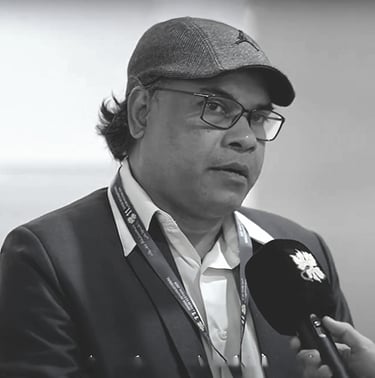
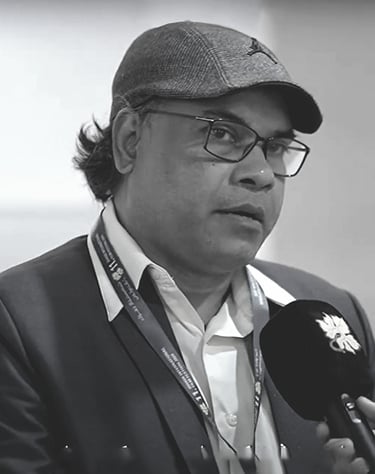
Ashraf Shishir
Luminous Frames & International Emmy Awards Juror | Golden Globe Voter
© 2026. All rights reserved.